Fact sheet
- Latin name
- Vulpecula (Vul)
- Brightest star
- Anser (α Vul)
- Relative brightness
- 4.44 mag
- Hipparcos catalogue
- HIP 95771
- Area
- 268 deg² (rank: 55 out of 88)
- Right ascension
- 18h 57m 07s to 21h 30m 39s
- Declination
- +19° 23' 54'' to +29° 29' 14''
- Neighbouring constellations
- Cygnus, Lyra, Hercules, Sagitta, Delphinus, Pegasus
Visibility
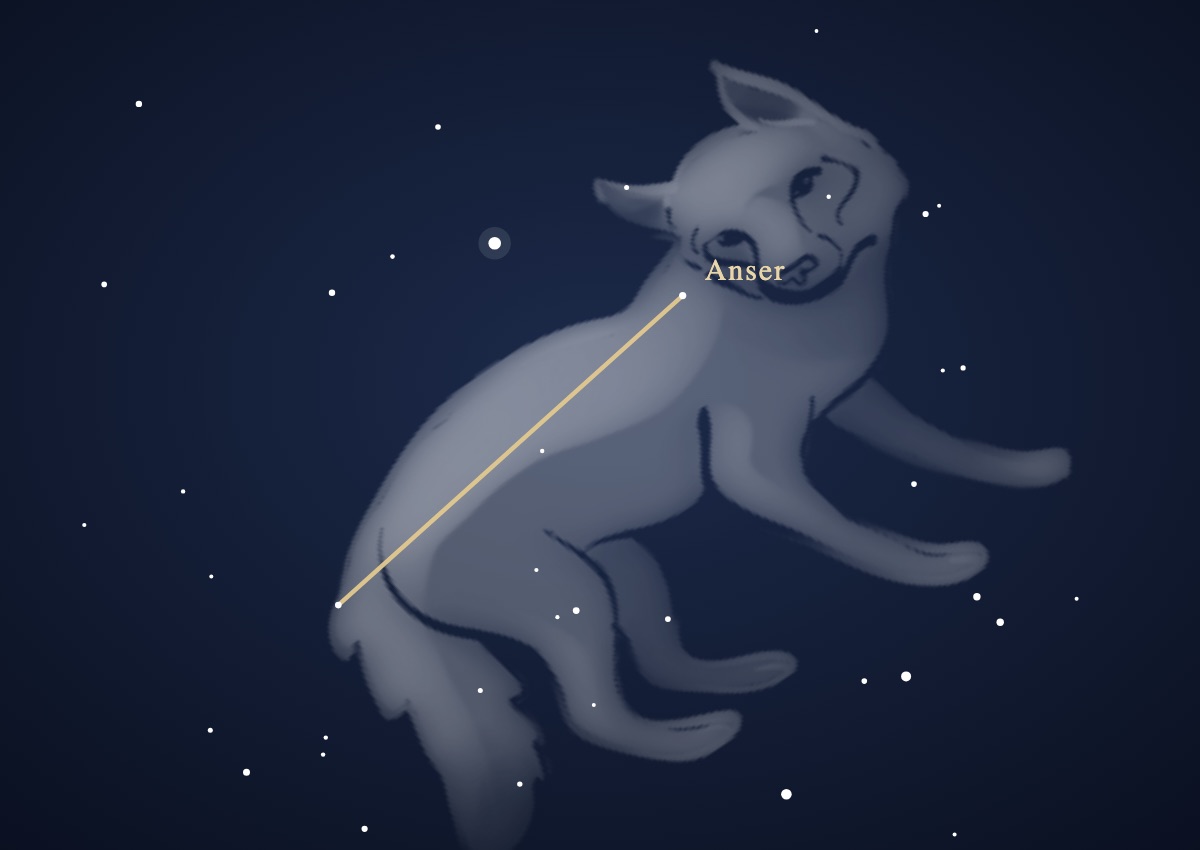
The constellation Vulpecula
Vulpecula is a constellation of the northern hemisphere. Its stars are not very noticeable, but this constellation contains Messier 27 (M 27), the so-called Dumbbell Nebula, one of the most beautiful planetary nebulae. It is a cloud of gas that was thrown off by a dying star. This beautiful object can already be seen with a good pair of binoculars. However, to make out the handles of the dumbbell, you need an eight-inch reflecting telescope. At observing events, interested people sometimes have the opportunity to look through a thirty-five-inch Dobsonian telescope. With this professional instrument, the Dumbbell Nebula can be seen in all its beauty.
History
The constellation was first introduced by Johannes Hevelius (astronomer and founder of the mapping of the Moon) in 1690 in his star atlas “Firmamentum Sobiescianum”. At that time it still showed a fox carrying a goose in its mouth. Originally this constellation was called Vulpecula cum Ansere (little fox with goose). However, over the centuries the goose disappeared from the constellation. The brightest star of the constellation Vulpecula still bears the name Anser (goose) today.
In 1967 there was great excitement about the constellation Vulpecula. The young doctoral student Jocelyn Bell was working at the Mullard Radio Astronomy Observatory near Cambridge with a completely new radio telescope. While analysing the data, she noticed a signal that repeated at regular intervals. Jocelyn Bell and her doctoral supervisor Antony Hewish could not explain this blinking signal at first and half-jokingly thought of a radio signal from an alien civilisation. They unofficially named the object LGM-1 (Little Green Men 1). However, it soon turned out that LGM-1 was a pulsar, a pulsating neutron star. For that time, however, this discovery was spectacular. Accordingly, Antony Hewish received the Nobel Prize in Physics in 1974, which he shared with Martin Ryle. Jocelyn Bell, who had discovered the signal, came away empty-handed. LGM-1 is regarded as the first pulsar ever discovered, and today it bears the official designation PSR J1921+2153.