Fact sheet
- Latin name
- Horologium (Hor)
- Brightest star
- α Horologii (α Hor)
- Relative brightness
- 3.85 mag
- Hipparcos catalogue
- HIP 19747
- Area
- 249 deg² (rank: 58 out of 88)
- Right ascension
- 2h 12m 49s to 4h 20m 18s
- Declination
- -67° 02' 09'' to -39° 38' 13''
- Neighbouring constellations
- Eridanus, Hydrus, Reticulum, Dorado, Caelum
Visibility
The constellation Horologium
Horologium (pendulum clock) is a constellation of the southern hemisphere. It is partly circumpolar around the South Pole. This means that some of its stars are so close to the celestial pole that they never set as seen from Sydney. Part of the constellation is therefore above the horizon all year round there.
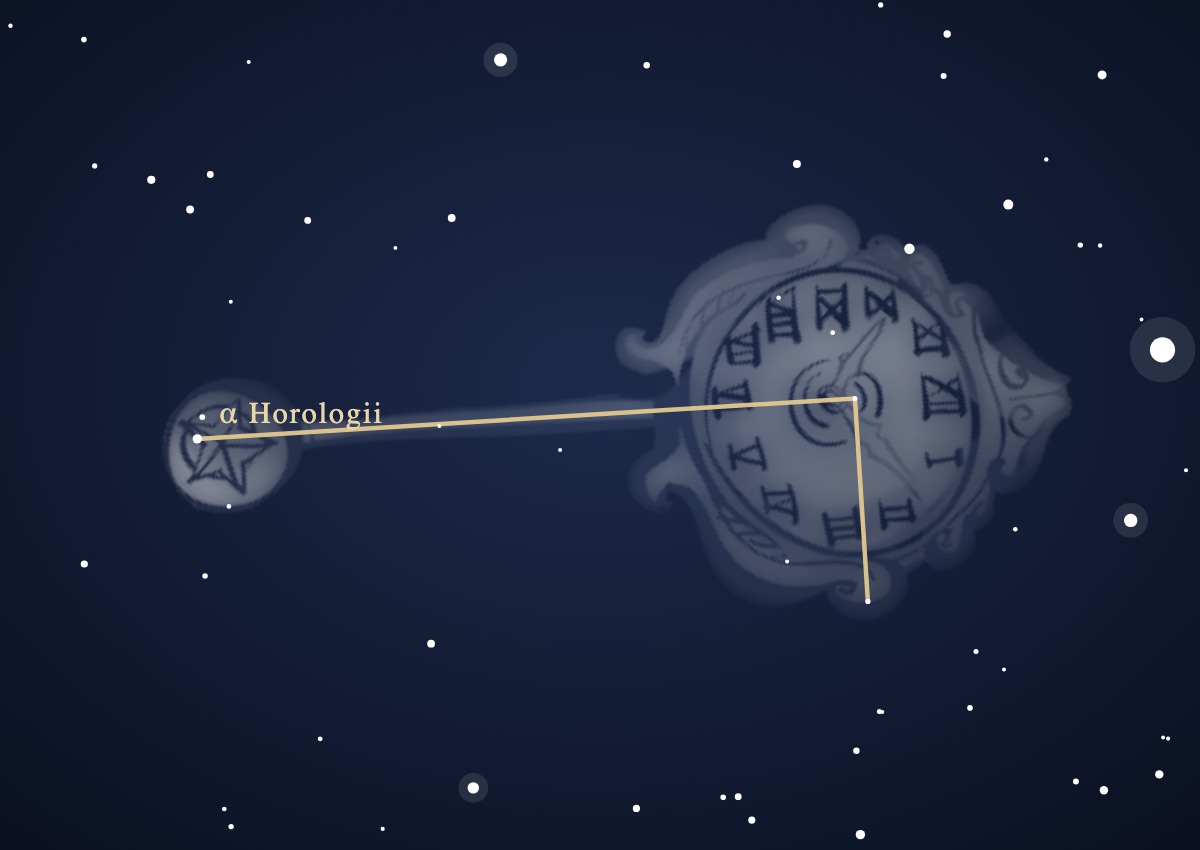
Its brightest star is α Horologii, which represents the pendulum of the clock in the constellation. It lies near the border with the constellation Eridanus. The constellation itself is easy to find thanks to Eridanus' very bright main star, Achernar.
Its star R Horologii is a Mira-type star. This means that its brightness can change greatly within a relatively short time. R Horologii changes its brightness in a cycle of about 408 days. During this cycle, it varies between a maximum of 4.7 mag and a minimum of 14.3 mag. At best, it can therefore be seen in the sky with the naked eye; at worst, a good telescope is needed.
History
The French theologian Nicolas-Louis de Lacaille, who devoted his life to astronomy, geodesy and mathematics, introduced 14 new constellations of the southern hemisphere. In 1750, he set off on a four-year journey to the Cape of Good Hope in order to observe, among other things, the constellations of the southern sky. During this time, he catalogued almost 10,000 stars. Nicolas-Louis de Lacaille named most of his new constellations after technical instruments. In this way, the constellations Sculptor, Fornax, Caelum, Antlia, Pictor, Microscopium, Reticulum, Octans, Horologium, Pyxis, Mensa, Telescopium, Norma and Circinus came into being. He also divided the large ancient constellation Argo Navis into the three constellations Carina, Puppis and Vela. His star catalogue of the southern sky was published in 1763, one year after his death, under the title “Coelum Australe Stelliferum”. What his 14 new constellations have in common is that they consist of relatively faint stars.
Nicolas-Louis de Lacaille named the constellation after the invention of his Dutch fellow scientist Christiaan Huygens (1629–1695). Christiaan Huygens was an astronomer, mathematician and physicist and invented the first pendulum clock in 1656. He published his findings on this in his treatise “Horologium Oscillatorium”, which appeared in 1673.