Fact sheet
- Latin name
- Caelum (Cae)
- Brightest star
- α Caeli (α Cae)
- Relative brightness
- 4.46 mag
- Hipparcos catalogue
- HIP 21770
- Area
- 125 deg² (rank: 81 out of 88)
- Right ascension
- 4h 19m 32s to 5h 05m 01s
- Declination
- -48° 44' 18'' to -27° 01' 30''
- Neighbouring constellations
- Lepus, Eridanus, Horologium, Dorado, Pictor, Columba
Visibility
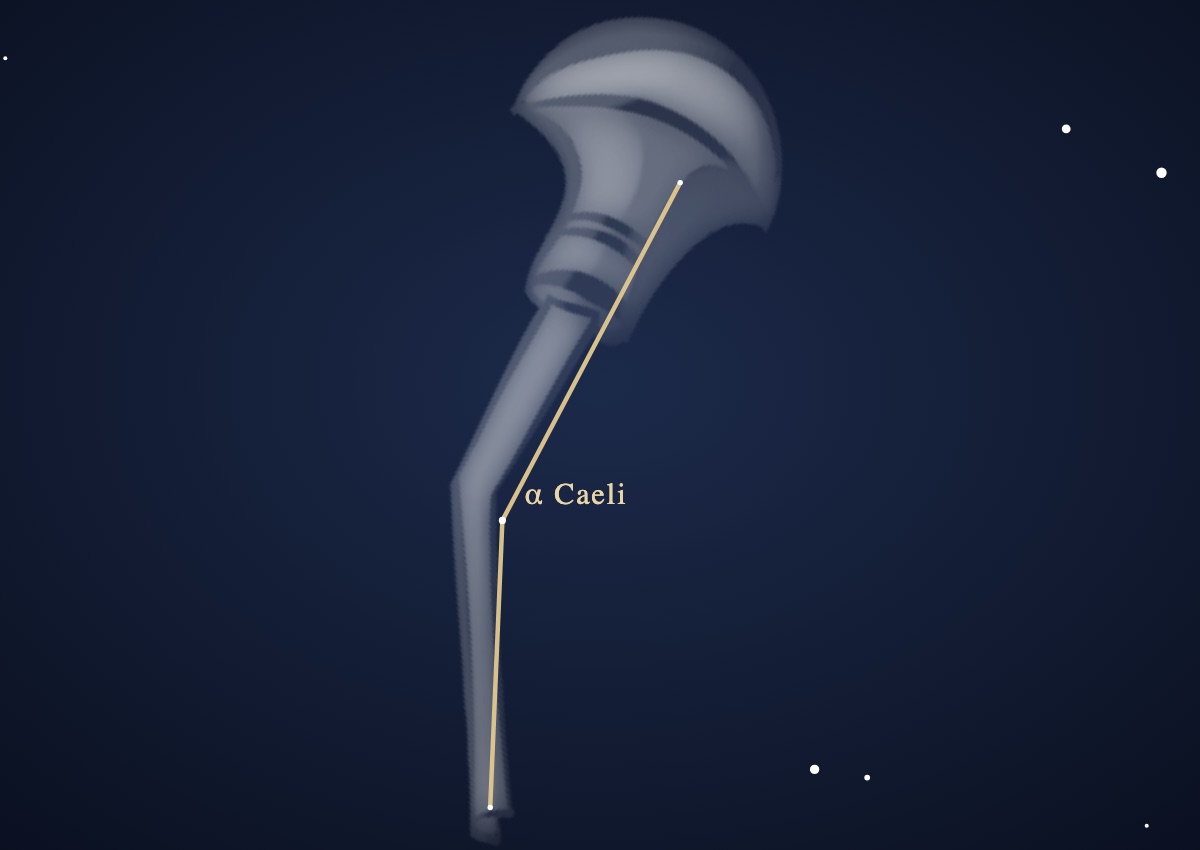
The constellation Caelum
Caelum is a constellation of the southern hemisphere. Its brightest star is α Caeli, which has an apparent magnitude of only 4.46 mag. Caelum lies between the river Eridanus in the west, Lepus in the north and Columba in the east.
History
The French theologian Nicolas-Louis de Lacaille, who devoted his life to astronomy, geodesy and mathematics, introduced 14 new constellations of the southern hemisphere. In 1750, he set off on a four-year journey to the Cape of Good Hope in order to observe, among other things, the constellations of the southern sky. During this time, he catalogued almost 10,000 stars. Nicolas-Louis de Lacaille named most of his new constellations after technical instruments. In this way, the constellations Sculptor, Fornax, Caelum, Antlia, Pictor, Microscopium, Reticulum, Octans, Horologium, Pyxis, Mensa, Telescopium, Norma and Circinus came into being. He also divided the large ancient constellation Argo Navis into the three constellations Carina, Puppis and Vela. His star catalogue of the southern sky was published in 1763, one year after his death, under the title “Coelum Australe Stelliferum”. What his 14 new constellations have in common is that they consist of relatively faint stars.
Caelum was originally meant to show a pair of crossed engraving tools, which Nicolas-Louis de Lacaille recorded under the French name “Les Burins”. They were meant to recall the tools of a copper engraver. Later, however, one of the two engraving tools disappeared, and the name of the constellation was Latinised to “Caelum”.