Fact sheet
- Latin name
- Ara (Ara)
- Brightest star
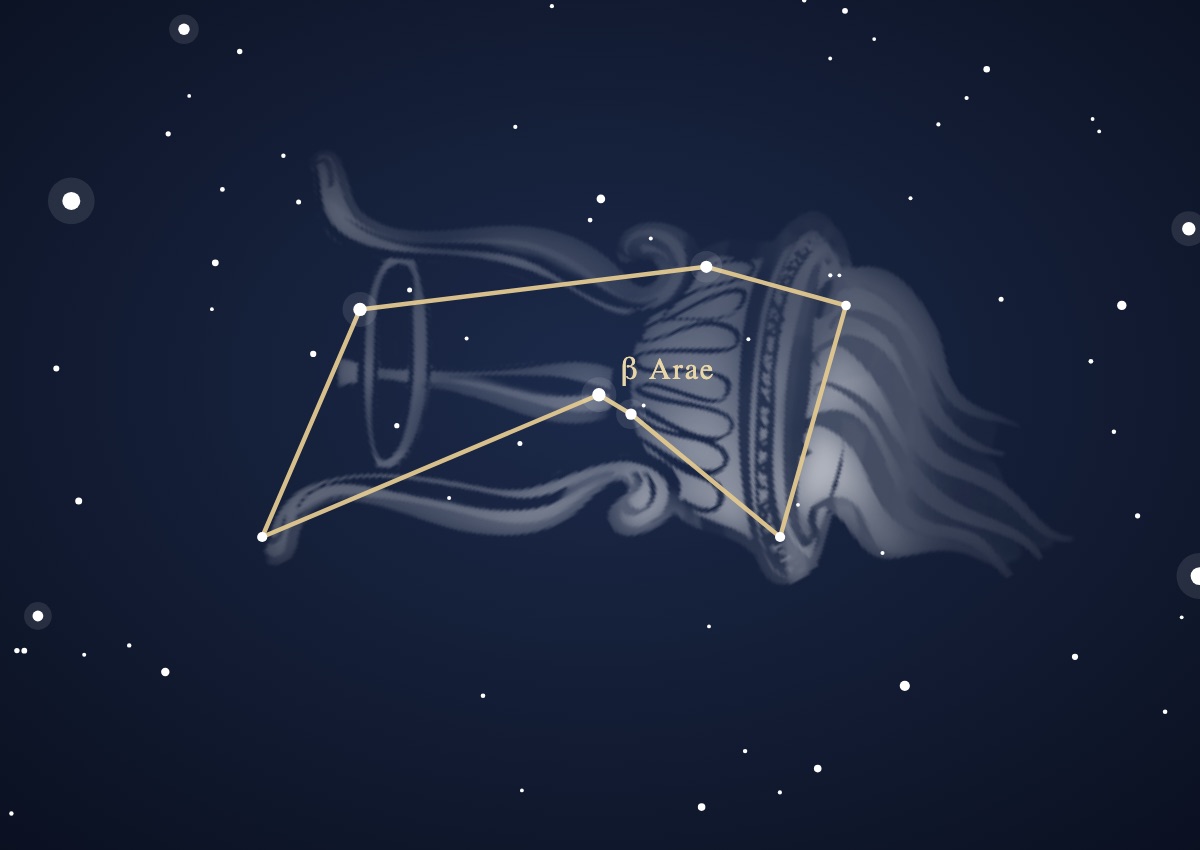
- β Arae (β Ara)
- Relative brightness
- 2.84 mag
- Hipparcos catalogue
- HIP 85258
- Area
- 237 deg² (rank: 63 out of 88)
- Right ascension
- 16h 34m 17s to 18h 10m 41s
- Declination
- -67° 41' 26'' to -45° 29' 10''
- Neighbouring constellations
- Scorpius, Norma, Triangulum Australe, Apus, Pavo, Telescopium, Corona Australis
Visibility
The constellation Ara
Ara is a constellation of the southern hemisphere. It is partly circumpolar around the South Pole. This means that some of its stars are so close to the celestial pole that they never set as seen from Sydney. Part of the constellation is therefore above the horizon all year round there.
The brightest star of the constellation is β Arae, which lies south of the tail of the constellation Scorpius. Its light takes about 600 years to reach Earth. The Milky Way runs through the constellation Ara. The Milky Way is a galaxy in its own right and consists of billions of stars. As a result, the constellation Ara gets its brilliance from several open clusters and globular clusters. Its most impressive globular cluster is NGC 6397, which, with a little luck, can already be observed with medium-sized binoculars. It is 8,000 light years away from Earth and is therefore the second closest globular cluster after M4 in the constellation Scorpius.
History and mythology
The constellation was already known to the ancient Greeks, and over thousands of years its stars have been interpreted by many different peoples. The Hebrews saw in the constellation the altar of Noah, which he built after the Flood, or the altar of Abraham, on which he was to sacrifice his son Isaac. Some celestial atlases also mention the centaur Chiron (constellation Centaurus), who sacrificed a wolf (constellation Lupus) on this altar. This interpretation arises from the proximity of the constellations Centaurus and Lupus: Aratus already describes how the centaur stretches out his hand towards the altar. However, no legend of its own about this has come down to us.
However, the best-known myth about the constellation Ara goes back to the Greeks. They believed that it was the altar at which Zeus and the gods swore to destroy the Titans. Zeus was a son of the Titan Cronus, who was then the ruler of the universe. Cronus had been warned that one of his children would destroy him. For this reason, he swallowed them. Only Zeus was saved by his mother. Many years later, Zeus returned and gave Cronus an emetic, after which Cronus vomited up Zeus's brothers and sisters. From then on, the gods (Zeus and his brothers and sisters) waged war against the Titans for 10 years. The gods won and divided the world among themselves. Poseidon became ruler of the sea, Hades ruler of the underworld and Zeus ruler of the sky.