Fact sheet
- Latin name
- Indus (Ind)
- Brightest star
- α Indi (α Ind)
- Relative brightness
- 3.11 mag
- Hipparcos catalogue
- HIP 101772
- Area
- 294 deg² (rank: 49 out of 88)
- Right ascension
- 20h 28m 41s to 23h 27m 59s
- Declination
- -74° 27' 16'' to -44° 57' 32''
- Neighbouring constellations
- Microscopium, Sagittarius, Telescopium, Pavo, Octans, Tucana, Grus
Visibility
The constellation Indus
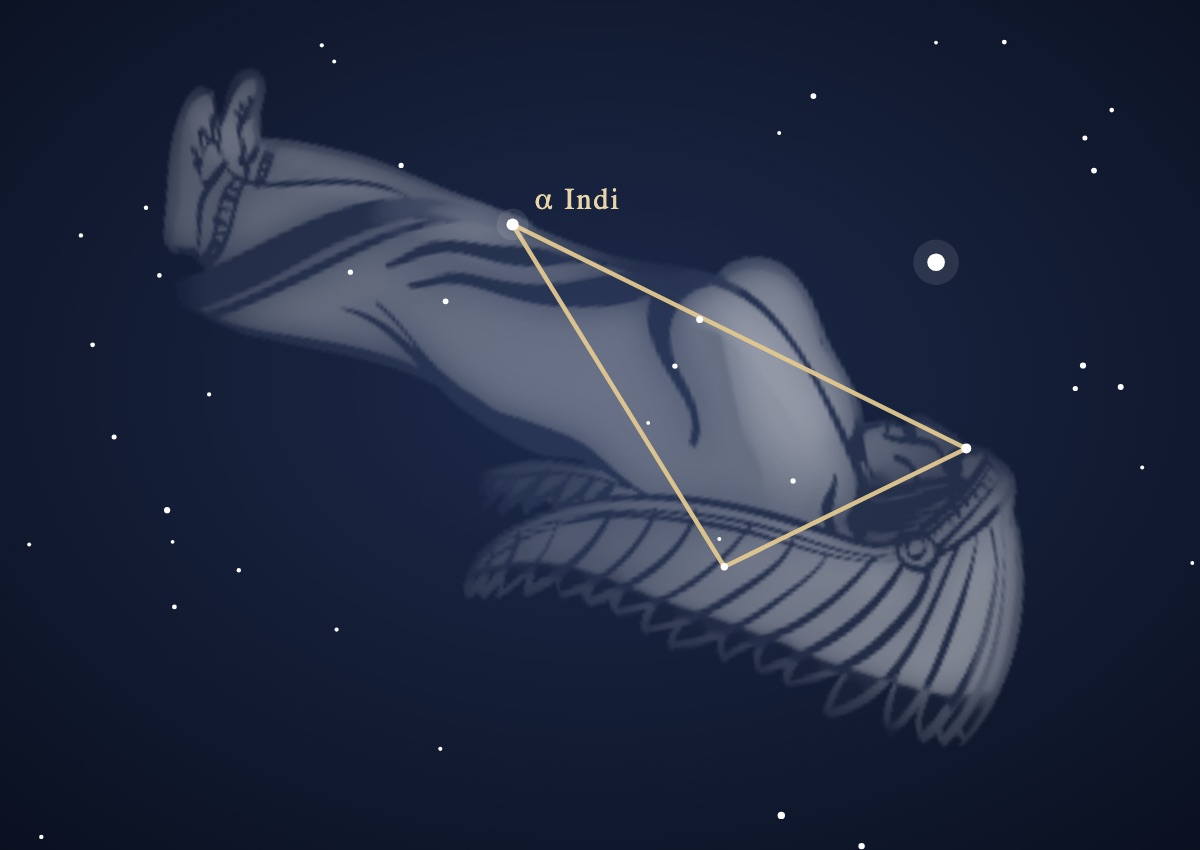
Indus is a constellation of the southern hemisphere. It is partly circumpolar around the South Pole. This means that some of its stars are so close to the celestial pole that they never set as seen from Sydney. Part of the constellation is therefore above the horizon all year round there. Its brightest star is α Indi, which represents the body of the Native American. At just under 12 light years away, the star ε Indi is one of the sun's nearest neighbours. It is orbited by two brown dwarfs and a gas giant, which the James Webb Space Telescope photographed directly in 2024.
The constellation Indus lies south-west of the constellation Grus and extends as far as the constellation Octans, which lies at the south celestial pole. The constellation Octans is the southern counterpart of the constellation Ursa Minor in the northern hemisphere. This constellation contains the southern pole star, σ Octantis. Because it is so close to the South Pole, it is the only star of the southern sky that always stands in the same place in the sky.
History
While the constellations of the northern hemisphere have been known since ancient times and are based on many different mythologies, many constellations of the southern hemisphere remained unnamed for a long time. It was not until the 16th century that people began to deal with them. Between 1595 and 1597, the Dutch seafarers Pieter Dirkszoon Keyser (chief navigator) and Frederick de Houtman (brother of the captain) mapped the southern sky on an expedition on behalf of Petrus Plancius. Influenced by their experiences on their voyage to the East Indies, they named a dozen constellations: Chamaeleon, Musca, Volans, Indus, Grus, Apus, Pavo, Phoenix, Dorado, Hydrus, Triangulum Australe and Tucana.
The two Dutch seafarers travelled mainly in the Indian Ocean and probably never set foot in America themselves. It is therefore not surprising that this constellation is often also called "the Indian" (a person from India). On old star maps, he is shown as a native with arrows or spears in his hands. It is not certain whether a Native American or an inhabitant of the East Indies was meant. The model for this constellation was probably the Native Americans whom the Portuguese seafarer Magellan met in Patagonia and Tierra del Fuego at the beginning of the 16th century.