Fact sheet
- Latin name
- Perseus (Per)
- Brightest star
- Mirfak (α Per)
- Relative brightness
- 1.79 mag
- Hipparcos catalogue
- HIP 15863
- Area
- 615 deg² (rank: 24 out of 88)
- Right ascension
- 1h 29m 38s to 4h 51m 22s
- Declination
- +30° 55' 19'' to +59° 06' 17''
- Neighbouring constellations
- Cassiopeia, Andromeda, Triangulum, Aries, Taurus, Auriga, Camelopardalis
Visibility
The constellation Perseus
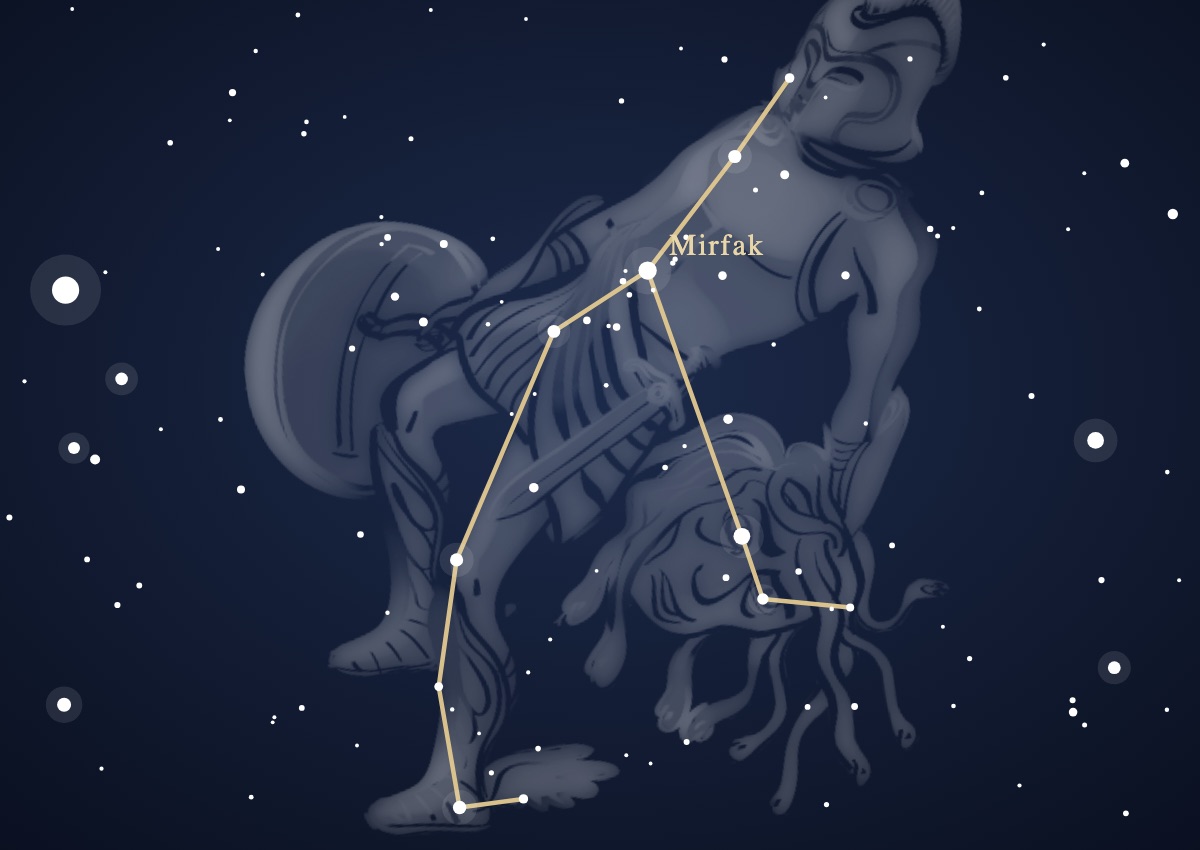
The constellation Perseus is a constellation of the northern hemisphere. It is partly circumpolar around the North Pole. This means that some of its stars are so close to the celestial pole that they never set as seen from Berlin. Its brightest star is α Persei, with the Arabic name Mirfak (elbow). Even more interesting to observe is β Persei, in Arabic Algol (head of the demon). Algol consists of three stars. Two of them orbit each other so closely that the cooler one partly covers the hotter one every 2.87 days. Algol then becomes noticeably fainter for a few hours. It represents the right eye in the cut-off head of the Gorgon Medusa and since ancient times has been regarded as the star of bad luck, the flickering eye of Medusa. Every year between 11 and 13 August, the Perseids, the best-known meteor shower, pass through the constellation. With a little luck, up to 100 shooting stars per hour can then be seen.
Mythology
In Greek mythology, Perseus was the son of Danae, the daughter of the king of Argos. Her father held her prisoner in a dungeon, because it had been prophesied to him that his grandson would one day kill him. However, Zeus entered the dungeon as a shower of golden rain and made Danae pregnant. When the king noticed this, he locked Danae and her son Perseus in a wooden chest and left them on the open sea. The chest was washed ashore on the island of Seriphos, where the fisherman Dictys found it and brought up Perseus like his own son. Dictys's brother, King Polydectes, desired Danae and wanted to get rid of Perseus, who stood in his way. He pretended that he wanted to marry another woman and asked his subjects for horses as a wedding present. Since Perseus did not own a horse, he was given the almost impossible task of bringing him the head of the Gorgon Medusa. The Gorgons were three winged sisters: Euryale, Stheno and Medusa. All three had snakes instead of hair. Euryale and Stheno were immortal; only Medusa was mortal. Anyone who saw her terrible face was immediately turned to stone. With the help of the gods, who gave him a mirrored shield, winged shoes and a cap of invisibility, Perseus cut off the sleeping Medusa's head. The next morning he flew on, and on his way he rescued the princess Andromeda, who was to be sacrificed to the sea monster Cetus. He then asked for her hand in marriage. With her, he flew back to Seriphos, used the head of Medusa to turn Polydectes to stone and handed the throne to Dictys. Years later, Perseus took part in athletic games in Larissa. There he accidentally struck his grandfather with a discus and killed him. So the prophecy was fulfilled after all.