Fact sheet
- Latin name
- Pegasus (Peg)
- Brightest star
- Enif (ε Peg)
- Relative brightness
- 2.38 mag
- Hipparcos catalogue
- HIP 107315
- Area
- 1,121 deg² (rank: 7 out of 88)
- Right ascension
- 21h 08m 43s to 0h 14m 58s
- Declination
- +2° 19' 32'' to +36° 36' 25''
- Neighbouring constellations
- Lacerta, Cygnus, Vulpecula, Delphinus, Equuleus, Aquarius, Pisces, Andromeda
Visibility
The constellation Pegasus
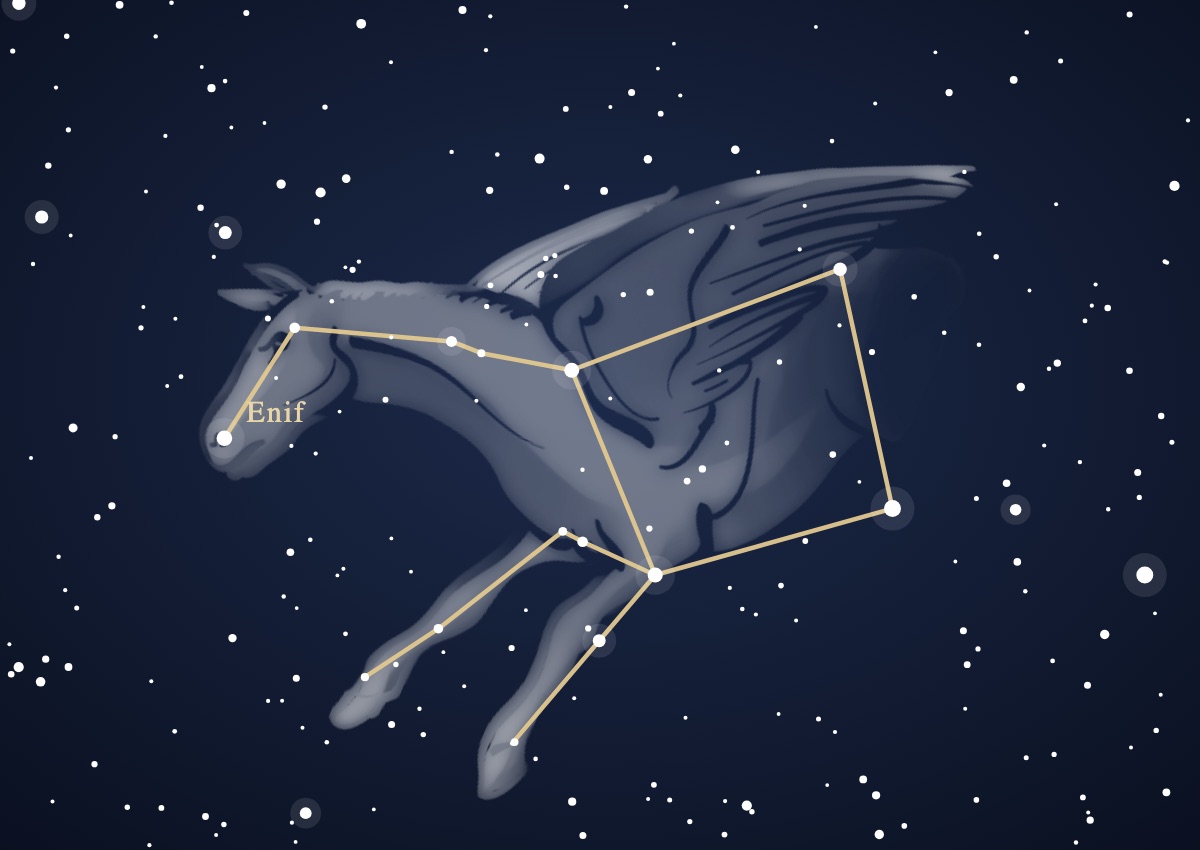
Pegasus is a constellation of the northern hemisphere. It is mainly known for its square of stars. The brightest star of the square is α Andromedae, and it actually lies in the constellation Andromeda. In the past it was counted as part of both constellations (also as δ Pegasi), but with today's constellation boundaries (1928) it was assigned to Andromeda. α Andromedae is also called Sirrah (navel of the horse). Another star of the square is α Pegasi, also known as Markab (from the Arabic mankib, “shoulder”, meaning the shoulder of the horse). The square is completed by β Pegasi (Scheat, meaning: shin) and γ Pegasi (Algenib, meaning: flank). However, the brightest star of the constellation is ε Pegasi, with the Arabic name Enif (nose). Enif is a dying star and could end its life in a supernova explosion at any time, but perhaps only in a few million years. That would cost Pegasus its head. In 1995, the first planet orbiting a sun-like star was discovered around the star 51 Pegasi (Nobel Prize in Physics 2019).
Mythology
The mother of Pegasus was Medusa, one of the three Gorgons. In her youth Medusa was famous for her incredible beauty. Many young men courted her, but she lost her virginity to Poseidon, the god of the sea, to whom horses were sacred. Poseidon seduced Medusa in the temple of Athena, the goddess of warfare, wisdom, the arts and sciences, and peace. Athena was so angry about the violation of her temple that she turned Medusa into a monster with snakes for hair, long boar's tusks, armour of scales, arms of brass, glowing eyes, a tongue hanging out and golden wings. From then on, every living creature that looked at her was turned to stone. When the hero Perseus cut off Medusa's head, the winged horse Pegasus and the warrior Chrysaor, who were children of Poseidon, sprang from her body. Chrysaor later became the father of the three-headed giant Geryon, whom Hercules killed in his tenth labour. Pegasus flew away and was found by the Greek hero Bellerophon at the spring Peirene in Corinth. Bellerophon had been given the task of killing the Chimera, a fire-breathing hybrid creature that was shaped like a lion at the front, like a goat in the middle and like a snake at the back. Pegasus allowed him to tame him and, together with him, defeated the Chimera. After many adventures together, Bellerophon became overconfident and tried to reach the realm of the gods with Pegasus. Zeus did not like this, and he sent a gadfly, which stung Pegasus. Pegasus reared up, and Bellerophon fell back to Earth into a thorn bush. From then on he wandered through the land, crippled and blind. Pegasus, however, completed the journey to Olympus and from then on carried the thunderbolts of Zeus.