Fact sheet
- Latin name
- Antlia (Ant)
- Brightest star
- α Antliae (α Ant)
- Relative brightness
- 4.25 mag
- Hipparcos catalogue
- HIP 51172
- Area
- 239 deg² (rank: 62 out of 88)
- Right ascension
- 9h 26m 56s to 11h 05m 55s
- Declination
- -40° 25' 29'' to -24° 32' 33''
- Neighbouring constellations
- Hydra, Pyxis, Vela, Centaurus
Visibility
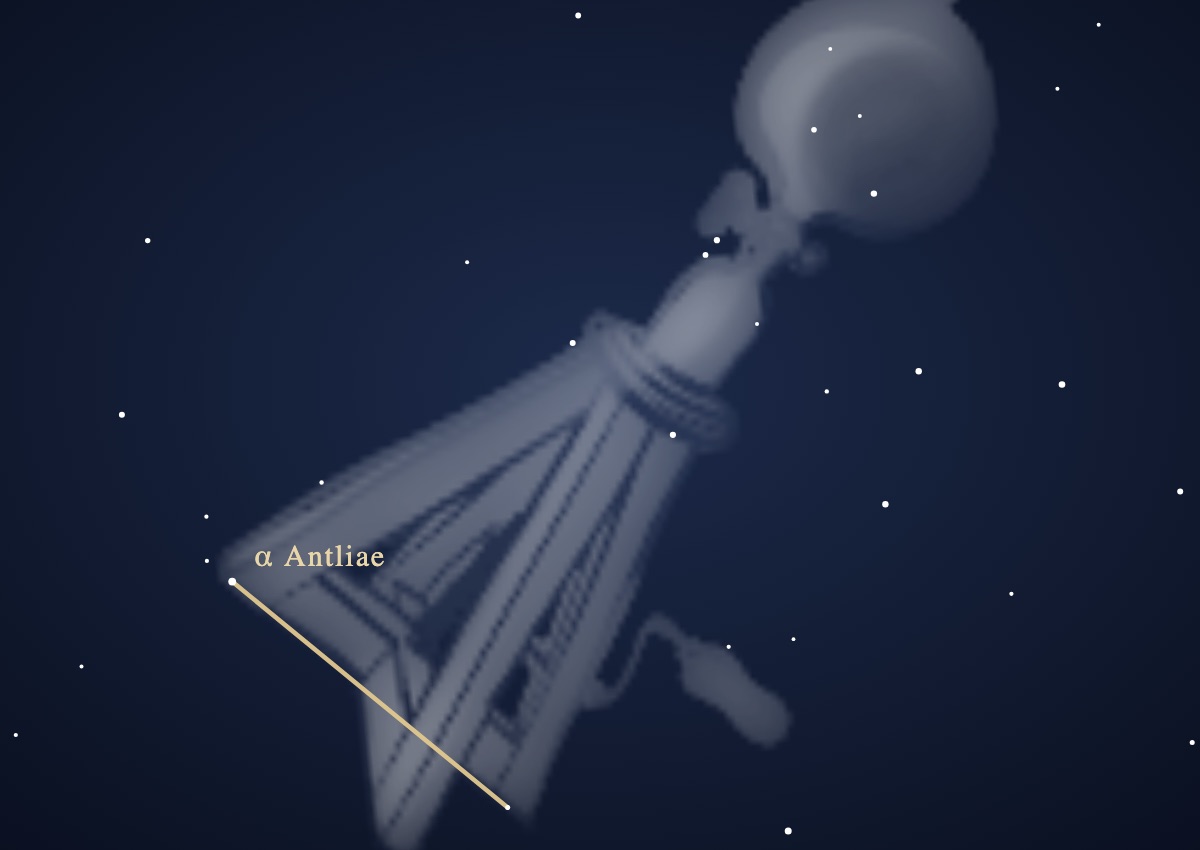
The constellation Antlia
Antlia is a constellation of the southern hemisphere. Its brightest star is α Antliae, which has an apparent magnitude of only 4.25 mag. Antlia lies near the constellation Argo Navis, which was already one of the best-known constellations of the southern sky in ancient times. However, the astronomers of the 18th century divided Argo Navis into three parts, because they found it too large and too difficult to survey. This created the keel (Carina), the poop deck (Puppis) and the sails (Vela) of the ship. Antlia lies north of Vela.
History
The French theologian Nicolas-Louis de Lacaille, who devoted his life to astronomy, geodesy and mathematics, introduced 14 new constellations of the southern hemisphere. In 1750, he set off on a four-year journey to the Cape of Good Hope in order to observe, among other things, the constellations of the southern sky. During this time, he catalogued almost 10,000 stars. Nicolas-Louis de Lacaille named most of his new constellations after technical instruments. In this way, the constellations Sculptor, Fornax, Caelum, Antlia, Pictor, Microscopium, Reticulum, Octans, Horologium, Pyxis, Mensa, Telescopium, Norma and Circinus came into being. He also divided the large ancient constellation Argo Navis into the three constellations Carina, Puppis and Vela. His star catalogue of the southern sky was published in 1763, one year after his death, under the title “Coelum Australe Stelliferum”. What his 14 new constellations have in common is that they consist of relatively faint stars.
The German engineer and physicist Otto von Guericke invented the air pump in 1650. A few years later, in 1658/59, the Irish natural philosopher Robert Boyle and the English physicist Robert Hooke developed the air pump further. Nicolas-Louis de Lacaille was so enthusiastic about the invention of the air pump that he named a constellation after it. He called it “Antlia Pneumatica”.