Fact sheet
- Latin name
- Sextans (Sex)
- Brightest star
- α Sextantis (α Sex)
- Relative brightness
- 4.49 mag
- Hipparcos catalogue
- HIP 49641
- Area
- 314 deg² (rank: 47 out of 88)
- Right ascension
- 9h 41m 05s to 10h 51m 30s
- Declination
- -11° 39' 44'' to +6° 25' 58''
- Neighbouring constellations
- Leo, Hydra, Crater
Visibility
The constellation Sextans
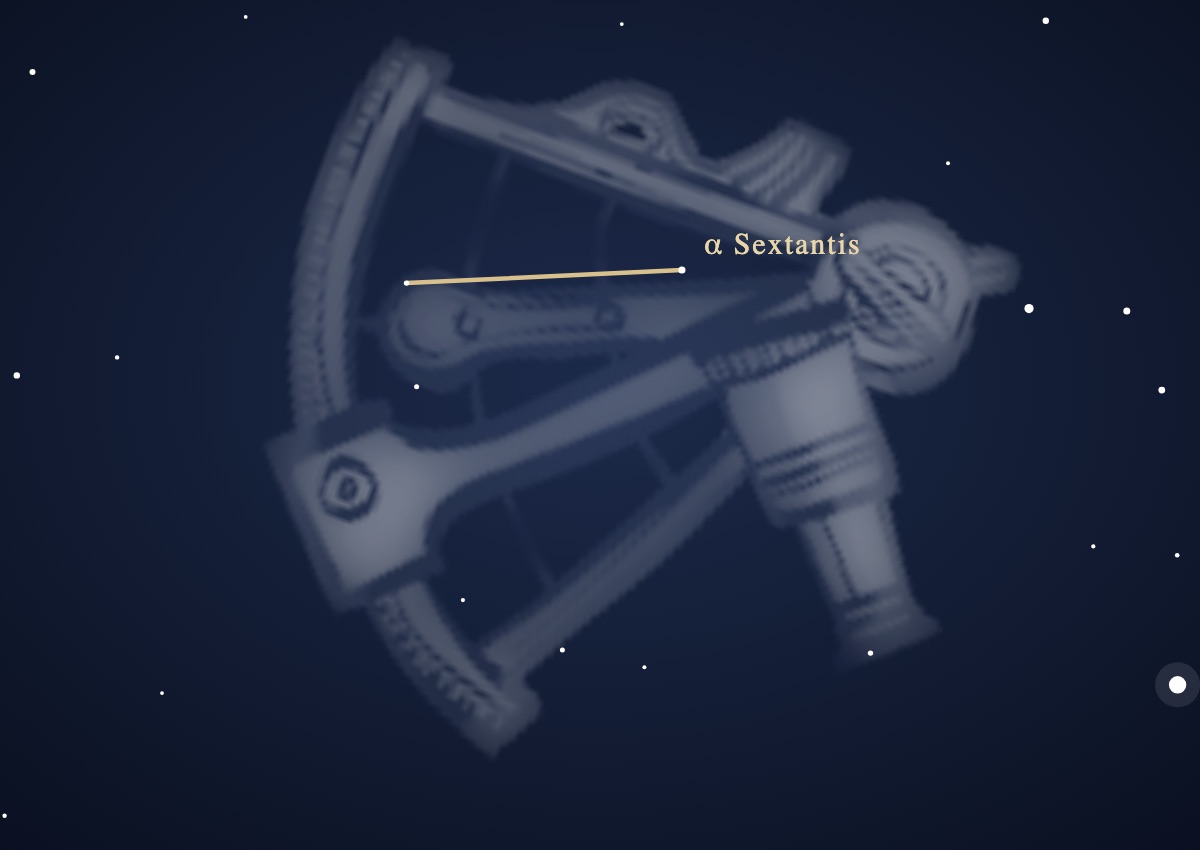
Sextans (sextant) is a constellation of the northern and the southern hemisphere. Its brightest star is α Sextantis. However, it can only be seen with the naked eye under a dark sky. The constellation is easiest to find in the sky with the help of the star Regulus. The star Regulus is the brightest star of the constellation Leo. South of the star Regulus lies the brightest star of the constellation Sextans, α Sextantis.
History
Johannes Hevelius (1611–1687) was an astronomer from Danzig (Gdańsk), which at that time belonged to the Kingdom of Poland, and the founder of the mapping of the moon. He did not create the constellation Sextans until 1687, shortly before his death, for his star atlas “Firmamentum Sobiescianum”. In this way he immortalised his favourite instrument for measuring the positions of the stars. Although the telescope had already been invented, Johannes Hevelius supported the exploration of the sky with the naked eye until the end of his life. A sextant is a sighting instrument. It can be used to measure angular distances of up to 60 degrees, which is exactly one sixth (Latin: sextans) of a full circle. However, Hevelius also used a telescope to measure and map the moon. His star atlas was only published after his death. His second wife, Elisabeth Koopmann, who had carried out research together with Johannes Hevelius during his lifetime, completed his work and published it in 1690. The constellations newly introduced by Johannes Hevelius all lie in regions with rather faint stars. They are the constellations Lacerta, Vulpecula, Canes Venatici, Leo Minor, Lynx, Scutum and Sextans. His wife Elisabeth Koopmann was one of the first women whose achievements in astronomy were recognised. To this day, she is regarded as the mother of moon charts.