Fact sheet
- Latin name
- Hydra (Hya)
- Brightest star
- Alphard (α Hya)
- Relative brightness
- 1.98 mag
- Hipparcos catalogue
- HIP 46390
- Area
- 1,303 deg² (rank: 1 out of 88)
- Right ascension
- 8h 10m 56s to 15h 02m 31s
- Declination
- -35° 41' 46'' to +6° 37' 49''
- Neighbouring constellations
- Crater, Sextans, Leo, Cancer, Canis Minor, Monoceros, Puppis, Pyxis, Antlia, Centaurus, Lupus, Libra, Virgo, Corvus
Visibility
The constellation Hydra
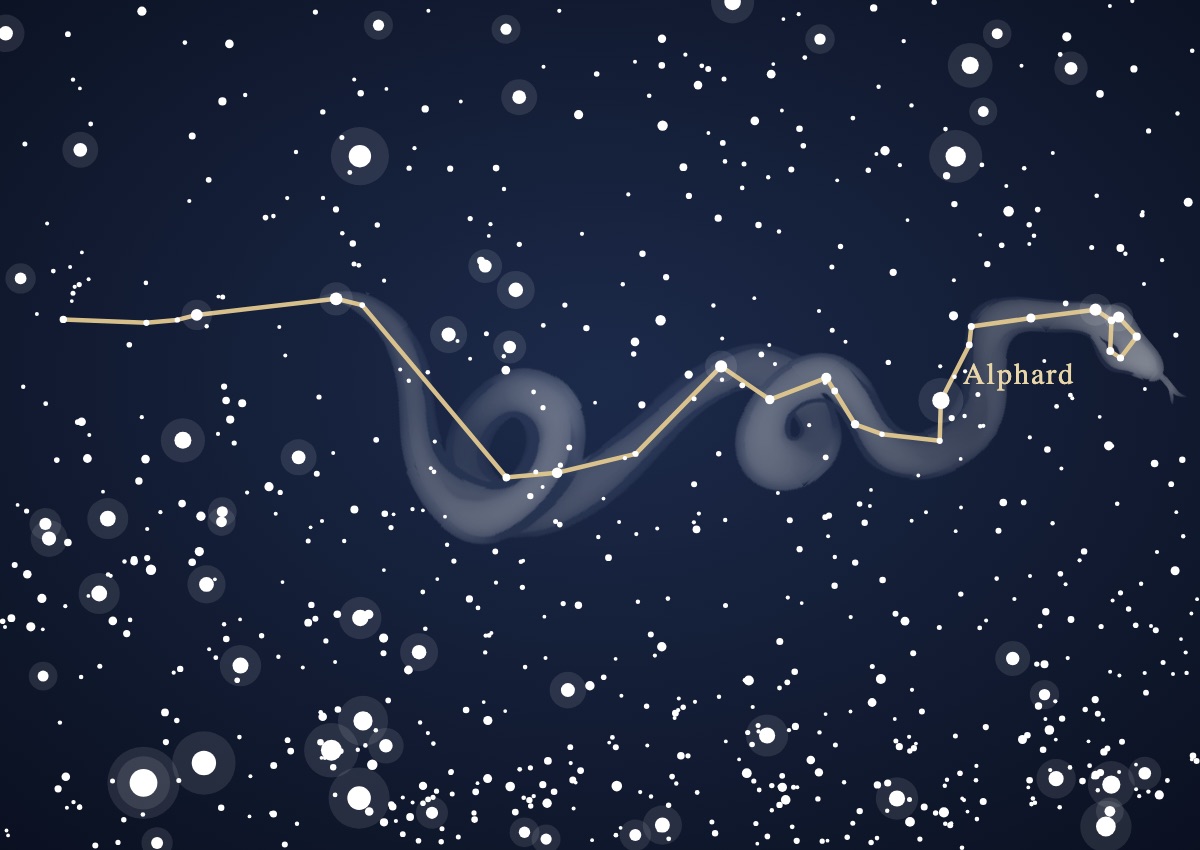
The constellation Hydra (water snake) is a constellation of the southern hemisphere. It is the largest and longest of all 88 constellations and winds its way across a quarter of the sky. Its brightest star is α Hydrae, which bears the Arabic name Alphard (the solitary one), as there is no other bright star near it.
Despite its size, Hydra is rather inconspicuous. However, its head, which consists of five stars, is quite easy to find by extending the line between Castor and Pollux in the constellation Gemini.
Mythology
The constellation is connected with two legends. The best known is about the monster Hydra, a snake with nine heads, the middle one of which was immortal. Because Hydra spread death and destruction, Hercules was sent to kill her. But for every head he cut off, two new ones grew back. In addition, Hera, the wife of Zeus, sent a giant crab to get rid of her husband's illegitimate child. Hercules crushed the crab, and Hera placed it in the sky (the constellation Cancer). In the end, Hercules defeated Hydra with the help of his charioteer Iolaus, who sealed each stump with fire. Hercules buried the immortal head under a rock. He dipped his arrows into Hydra's poisonous blood; they were to be useful to him later on. In the sky, Hydra was immortalised with only her immortal head.
The second legend is about a raven (Corvus), a water snake (Hydra) and a cup (Crater). The raven was the bird of Apollo, a son of Zeus, the father of the gods. When Apollo wanted to make a sacrifice to his father, he sent out the raven with a gilded cup to fetch fresh water from a spring. On the way, the raven spotted a fig tree whose fruits were not yet ripe. Although he was supposed to hurry, he could not resist and waited for several days until the figs were ripe. Full of food and looking for an excuse, he grabbed a water snake and told Apollo that it had blocked the way to the spring. Apollo saw through the lie and, as a punishment, took away the raven's ability to drink during the time when the figs ripen. Then he placed the raven (Corvus), the water snake (Hydra) and the cup (Crater) in the sky.