Fact sheet
- Latin name
- Ursa Major (UMa)
- Brightest star
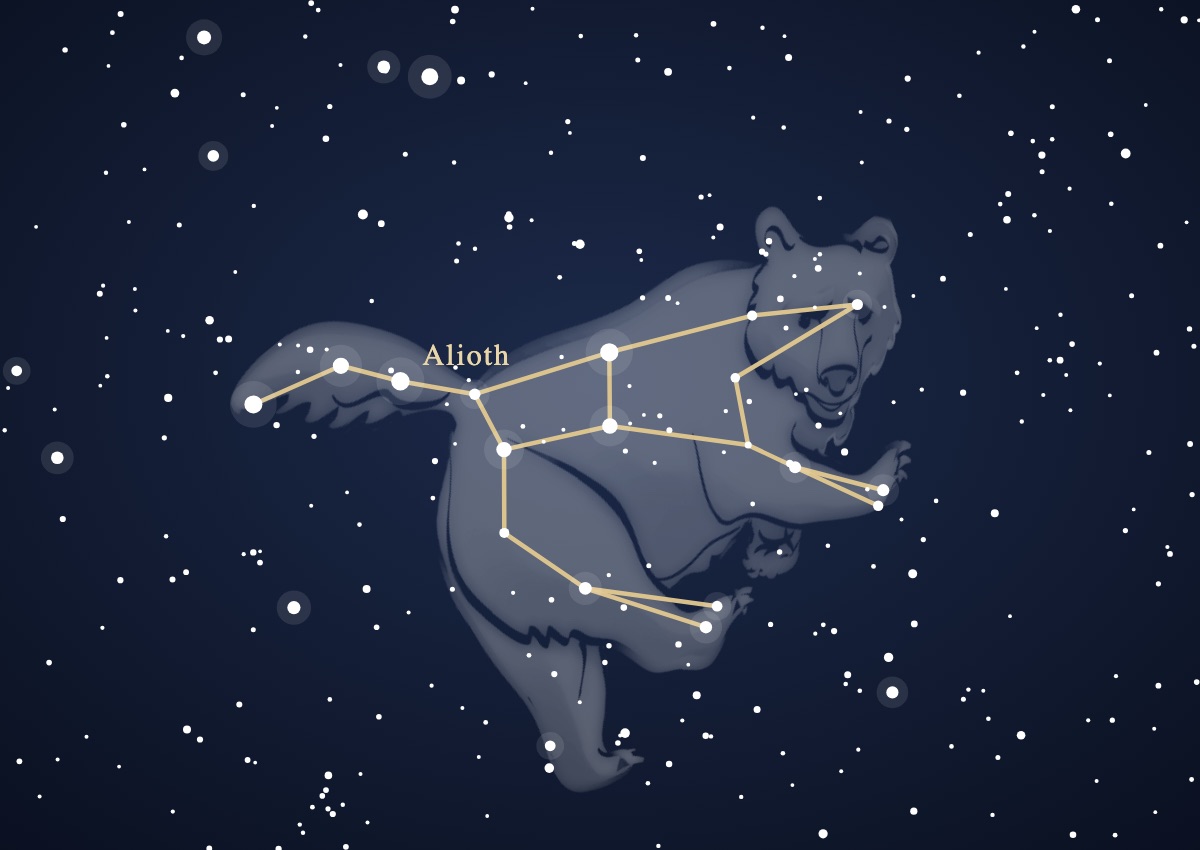
- Alioth (ε UMa)
- Relative brightness
- 1.76 mag
- Hipparcos catalogue
- HIP 62956
- Area
- 1,280 deg² (rank: 3 out of 88)
- Right ascension
- 8h 08m 31s to 14h 29m 00s
- Declination
- +28° 18' 14'' to +73° 08' 18''
- Neighbouring constellations
- Draco, Camelopardalis, Lynx, Leo Minor, Leo, Coma Berenices, Canes Venatici, Boötes
Visibility
The constellation Ursa Major
Ursa Major is a constellation of the northern hemisphere and the third largest in the sky. It is partly circumpolar around the North Pole. This means that some of its stars are so close to the celestial pole that they never set as seen from Berlin. Part of the constellation is therefore above the horizon all year round there.
The flank and the tail of the bear are formed by the seven stars of the Great Wagon. In the USA these stars are also known as the Big Dipper and in England as the Plough. For astronomers, the Great Wagon is not a constellation in its own right, but only a part of Ursa Major.
The star α Ursae Majoris bears the Arabic name Dubhe (bear). Its neighbouring star β Ursae Majoris bears the Arabic name Merak (flank). Together they form the front part of the Great Wagon. They are particularly important: with their help, you can easily find the pole star (the brightest star of the constellation Ursa Minor) and therefore the north celestial pole. If you extend the imaginary line between these two stars five times, you arrive almost directly at the pole star. There are no other bright stars on this imaginary line.
Mythology
Callisto was a nymph in the company of the goddess Artemis, the goddess of hunting. According to a Greek legend, Zeus one day turned himself into Artemis in order to get close to Callisto. Callisto suspected nothing until Zeus showed his true face and forced her to give in to him. Callisto became pregnant and, because she had broken her vow of chastity to Artemis, she was banished from the goddess's company. But for Callisto, who had been left alone with her shame, things were to become even worse. When she gave birth to her son Arcas, Hera, the betrayed wife of Zeus, could no longer hold back her jealousy. She threw Callisto to the ground and turned her into a she-bear. For fifteen years, Callisto roamed the forest in the form of a she-bear, until one day she met her son Arcas. She recognised her son and wanted to approach him. But Arcas, who had no idea who she was, tried to kill the she-bear. Before anything worse could happen, Zeus stepped in and sent a whirlwind that carried mother and son up into the sky. There he immortalised Callisto in the constellation Ursa Major (Great Bear). Some retellings see her son Arcas in Ursa Minor (Little Bear), but the ancient star myths see him in Boötes.