Fact sheet
- Latin name
- Aquila (Aql)
- Brightest star
- Altair (α Aql)
- Relative brightness
- 0.77 mag
- Hipparcos catalogue
- HIP 97649
- Area
- 652 deg² (rank: 22 out of 88)
- Right ascension
- 18h 41m 18s to 20h 38m 44s
- Declination
- -11° 51' 59'' to +18° 41' 18''
- Neighbouring constellations
- Sagitta, Hercules, Ophiuchus, Serpens Cauda, Scutum, Sagittarius, Capricornus, Aquarius, Delphinus
Visibility
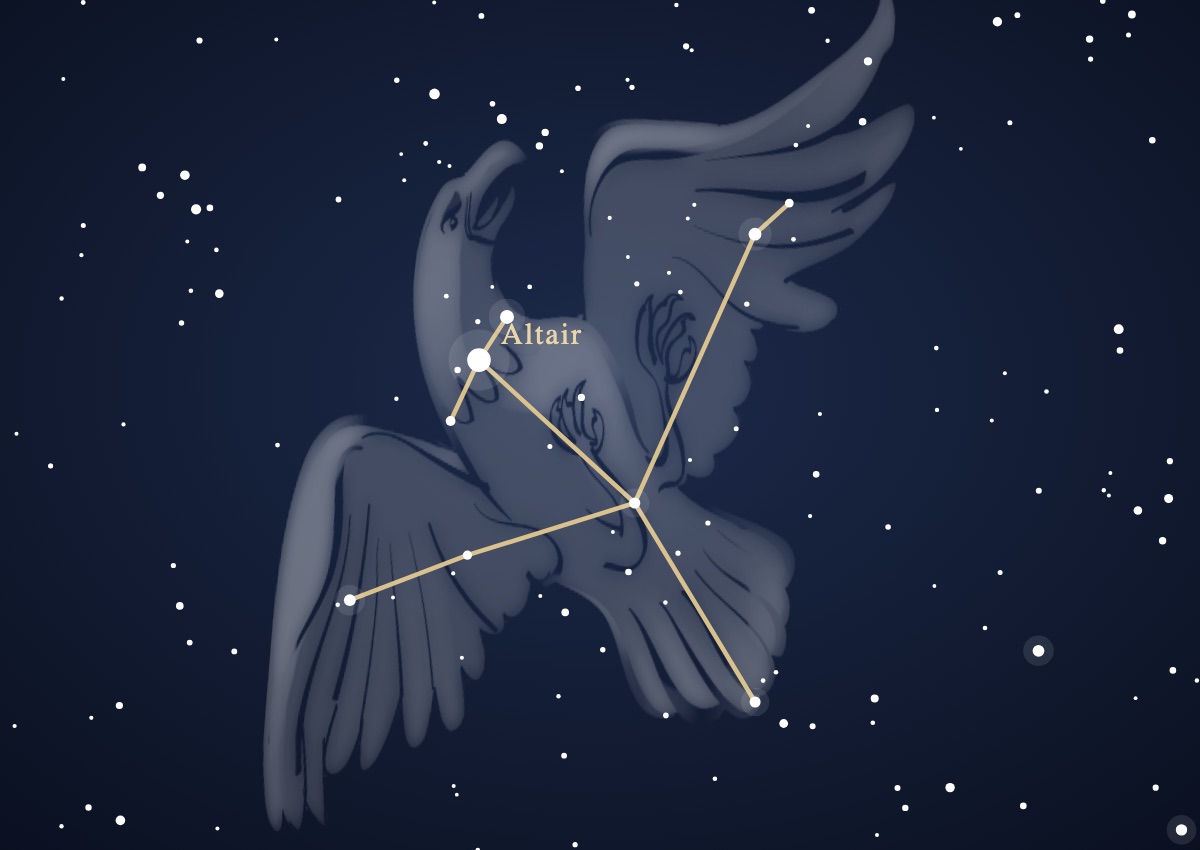
The constellation Aquila
Aquila is a constellation of the northern and the southern hemisphere. It can therefore be observed from anywhere in the world. Its brightest star is α Aquilae, which bears the Arabic name Altair (from an-nasr at-tair, “the flying eagle”). It is the twelfth brightest star in the sky.
Altair belongs to the famous Summer Triangle, a simple pattern of stars that is easy to find in the northern sky during the summer months. The other two stars are Vega, the brightest star of Lyra, and Deneb, the brightest star of Cygnus.
Mythology
The Titan Prometheus created humans and animals with the goddess Athena. He taught the humans the arts and sciences. When Zeus refused them fire, Prometheus stole it and secretly brought it down to Earth for them in a hollow fennel stalk. In his anger, Zeus created the beautiful Pandora and sent her to Earth with a box full of evils (Pandora's box), which brought disease and death upon the humans for all eternity. He had Prometheus chained to a rock forever, where every day the eagle Aethon ate from his liver, which always grew back. Only many centuries later did Hercules find him and kill the eagle with a poisoned arrow. However, Prometheus was only allowed to go free once an immortal was willing to die for him.
Before Hercules found Prometheus, he stopped at the cave of the centaur Pholus (centaurs are hybrid creatures with the upper body of a human and the lower body of a horse). There, a quarrel broke out over a jug of wine, in which Hercules had to defend himself and killed several centaurs. The others fled to Chiron, the wisest and most just of the centaurs. He was a friend of many gods and kings, had raised many of their children and had exceptional knowledge of medicine. During the chase, Hercules is said to have accidentally hit Chiron with a poisoned arrow. Because Chiron was immortal, he did not die, but from then on he suffered endless pain. He gave up his immortality, and this set Prometheus free. Zeus then placed the eagle, the arrow with which Hercules had killed the eagle, and Chiron himself in the sky as constellations.