Fact sheet
- Latin name
- Lepus (Lep)
- Brightest star
- Arneb (α Lep)
- Relative brightness
- 2.58 mag
- Hipparcos catalogue
- HIP 25985
- Area
- 290 deg² (rank: 51 out of 88)
- Right ascension
- 4h 55m 02s to 6h 12m 52s
- Declination
- -27° 16' 44'' to -10° 48' 50''
- Neighbouring constellations
- Orion, Eridanus, Caelum, Columba, Canis Major, Monoceros
Visibility
The constellation Lepus
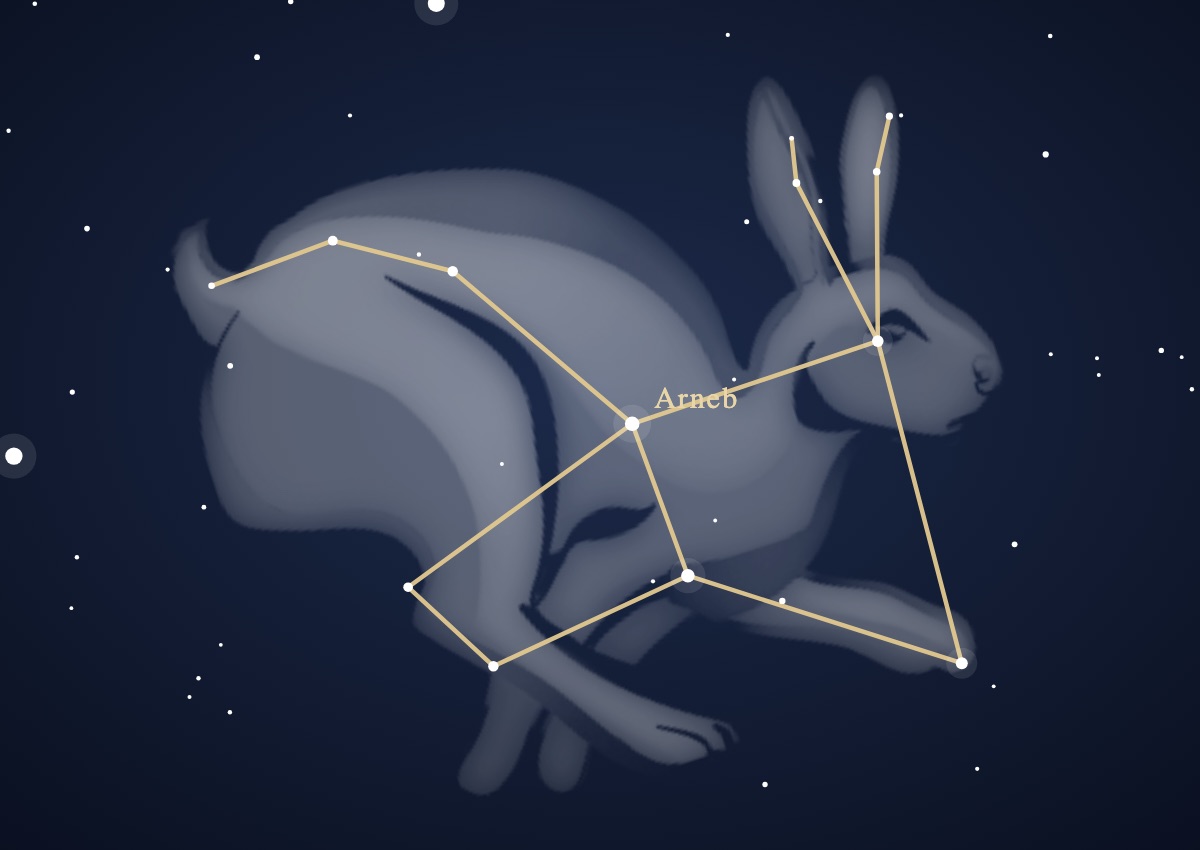
Lepus is a constellation of the southern hemisphere. Its brightest star is the star Arneb. Its name comes from the Arabic al-arnab and means "the hare". Thanks to its eastern neighbour, the constellation Canis Major, the constellation Lepus is easy to find in the sky. On its proud chest, Canis Major carries the brightest star in the sky, the star α Canis Majoris, which bears the Greek name Sirius (the scorching one). In the sky, the brightness of Sirius is exceeded only by the sun, the moon and some of the planets. Seen from the star Sirius, the brightest star of the constellation Lepus lies in a straight line to the west.
History and mythology
The constellation Lepus is one of the 48 original constellations of Ptolemy, a mathematician, astronomer, astrologer and geographer of antiquity. Over the centuries, the constellation has been associated with many myths. The Arabs saw in this constellation the throne of Orion. The Egyptians depicted this constellation as the boat of the god Osiris. In earlier times, the god Osiris was seen in the group of stars of Orion, and below him to the south lay his boat, in the constellation that is today Lepus. However, two other fables became the accepted ones:
The first is the fable of a greyhound (constellation Canis Major) that is chasing a hare (constellation Lepus). It goes back to the fact that the Greeks used to hunt hares with greyhounds.
The second is the somewhat better-known fable about Leros, a Greek island in the Aegean Sea. One day, someone brought a pregnant female hare to the island. Because there had been no hares on the island until then, the people were delighted with this animal and began to breed hares. As a result, the hares spread very quickly over the whole island and ate the crops in the fields, so that the inhabitants of the island had hardly any food left. The inhabitants caught the hares again and took them to the mainland. As a reminder that you can have too much of a good thing, the hare was then placed in the sky as a constellation.